
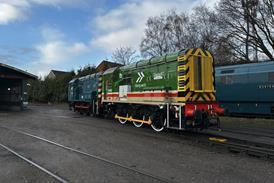

Vanguard’s HydroShunter project shows how a hydrogen Class 08 retrofit could decarbonise freight yards. Chief Engineer Charles Calvert explains the series-hybrid architecture combining hydrogen power with 1950s traction motors.
In the debate over rail decarbonisation, the shunting yard is the industry’s forgotten front line. While the sector argues over high-speed lines and heavy haul corridors, the humble shunter is required to perform high-torque, stop-start manoeuvres, often 24 hours a day.
For Charles Calvert, Chief Engineer at Vanguard, the challenge was clear: how do you decarbonise a Class 08 – the workhorse of the British rail freight industry – without sacrificing the multi-shift capability that diesel provides?
The project, developed in partnership with vehicle donor the Severn Valley Railway, has successfully transformed a 70-year-old asset into a testbed for 21st-century traction.
The mass paradox
Retrofiting a hydrogen drivetrain into the cramped ‘engine room’ of a Class 08 presented an immediate packaging conflict.
“It is no surprise that hydrogen in compressed gas form takes up more volume than your equivalent energy store in diesel,” explains Calvert. “A diesel tank on this is the full height of the shunter, but it is only 700mm wide. That is enough to keep operating for a fair while. Whereas for us, we use the entire top of the shunter – the full length of the engine room.”
Retractioning is way, way cheaper than buying a new shunter. It allows you to take an asset that you have got, that owes no money, that is not on finance… and keep it running from now into the future.”
However, in shunting, mass is a virtue. To move heavy freight trains, a locomotive needs high adhesive weight to prevent wheel slip. When Vanguard initially modelled the system using modern lithium-ion batteries, they hit an unexpected problem.
“We originally started designing around a lithium battery… but we actually found that we were coming in very light compared to the mass of the engine we were replacing,” says Calvert. “So, we got to the point where we said: why not use lead acid batteries?”
“I am former submarine service, and submarines have traditionally used lead acid batteries. Even nuclear submarines still use them because having all that mass in the keel is good for the centre of mass. We thought, it is more economical… why the hell not provide that mass with a lead acid battery which is there being useful?”
Series hybrid architecture
The resulting “Hydroshunter” represents a fundamental shift in drivetrain architecture. Unlike previous ‘parallel’ hybrids where the fuel cell and battery drive the wheels together, this unit is a series hybrid.
“Previously, we operated parallel hybrids where the fuel cell was providing traction power,” Calvert notes. “Because we are a series hybrid, the shunter will work up to its full capability in battery mode only. The battery provides that massive whack of power for a minute, or two minutes, to get the train up to speed. What hydrogen gives us is the ability to do that all day long.”
“If you look at an equivalent battery shunter using an equivalent chassis, you are looking at single-shift operation really, and a lot of downtime for charging. For us, it is all about multi-shift operation. We require minutes, not hours, to refuel.”
Solving the thermal headache
One of the specific engineering challenges of shunting is thermal management. Shunters typically operate at high power but low speeds, meaning they generate significant heat but create very little natural airflow to cool the system.

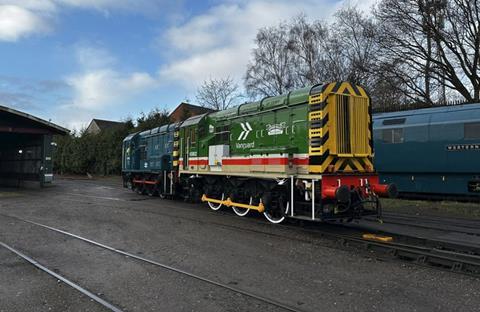
Vanguard’s hydrogen-powered HydroShunter demonstrator, a retrofitted British Rail Class 08 developed with the Severn Valley Railway to test modular fuel-cell and battery traction for rail decarbonisation. Credit: Vanguard Sustainable Transport Solutions[/caption]
“We do have a large radiator inside the radiator compartment,” Calvert says. “It is designed to deal with the full 80kW power output maximum out of the fuel cell.”
However, the series hybrid architecture simplifies the cooling challenge significantly. Because the fuel cell is not directly driving the wheels, it does not have to chase the erratic demands of the driver.
“The fuel cell will be in the mix when we are operating it… but it is not like we want full power so we have to kick the fuel cells up to maximum, and then with no power demand we kick them back down to minimum,” Calvert explains. “We are aiming to keep it operating at a steady charging power output. So, that already makes things in terms of fuel cell management a lot easier. You are not dealing with massive spikes.”
This ‘steady state’ operation allows the cooling system to be robust without being overly complex. “Even though we will be stationary, even though we will be operating backwards for half the time… it is very well provisioned in terms of thermal management because the real estate for thermal management is in excess.”
Interfacing with the 1950s
Perhaps the most impressive feat of engineering is the ‘handshake’ between 2026 control software and 1950s hardware. The Class 08 utilises DC series-wound traction motors – technology that is analog, passive and incredibly robust.
“Nothing in engineering is ever easy,” laughs Calvert. “But this has been the easiest interface we’ve had between a legacy locomotive and a modern hybrid traction system. The Class 08 is so simple. The motors are just sat there waiting to receive volts and amps.”
Vanguard removes the obsolete diesel prime mover and ‘drops in’ the new modular power pack. A system of DC-DC converters then steps down the voltage to match the legacy 90V requirement of the original motors.
“From the driver’s point of view, there is as little difference as possible,” Calvert says. “We have a few more switches and indicators in the cab desk – stating traction battery state of charge, for example – but otherwise when the driver is driving, he or she feels it operates exactly the same way.”
“They go to notch one, and it provides the same current as notch one. We are emulating what the resistance and the speed of the engine did, but we have a huge degree of control over it because it is software.”
https://www.youtube.com/watch?v=EFSTJt9Qi5E&list=PLvKutsVLegNHER_17nM3nTvrP_9FKCVpZ&index=7
The economic argument: new vs retro
Beyond the engineering, the project is driven by the hard economics of fleet renewal. With the cost of new rolling stock soaring, operators are looking for ways to avoid the capital expenditure of buying new machines ‘from the ground up’.
“You could make a modern Class 08,” Calvert argues. “But they are making that from the ground up, which means that you have to pay for it from the ground up.”
“Whereas there are loads of Class 08s… they were the most common type of loco made by British Rail back in the day. And they are still a lot in operation, useful operation, because they just do the job. The traction motors are solid. The chassis are good.”
The issue is purely the obsolescence of the diesel power unit. “The Class 08s are not getting any younger,” Calvert admits. “They use all kinds of imperial measurements that haven’t been made for 50 or 60 years. So, if something breaks – like a crankshaft – that can turn into a lump of scrap very unexpectedly.”
“You can either choose to try and keep your existing legacy technology going, cannibalising spares… or you can take the choice to re-traction. Retractioning is way, way cheaper than buying a new shunter. It allows you to take an asset that you have got, that owes no money, that is not on finance… and keep it running from now into the future.”
The maintenance reality
The retrofit also simplifies the physical logistics of maintenance. “When the diesel engine on this one got removed, the Severn Valley Railway had to hire a road crane because it was above the capacity of their depot crane. Whereas all of our modules are lifted by a 10-tonne crane, because it comes apart in bits.”
Crucially, Vanguard’s approach is pragmatic. Calvert acknowledges that while electrification is the ‘gold standard’, that capability comes at a ‘gold standard price’ that many freight yards simply cannot justify.
For those environments, he argues, there is only one viable path forward.
“For places where neither electrification nor batteries will work, hydrogen offers the only available decarbonisation solution,” Calvert concludes. “It allows us to take an asset you have already paid off and give it the exact same performance as a factory-fresh Class 08.”
Beyond the Class 08
While the Class 08 is the current focus, the technology driving it has broader ambitions. The power pack is designed as a modular and scalable architecture that can be applied to many other locomotives.
This flexibility has already allowed Vanguard to expand its research scope. “For example, we’ve used HydroShunter to trial metal hydride hydrogen solid state storage in a joint project with the University of Nottingham,” Calvert reveals.
This trial moves the project beyond a simple life-extension exercise. By testing advanced storage solutions on a working locomotive, Vanguard is validating the architecture for the next generation of heavy rail traction.
About the expert:
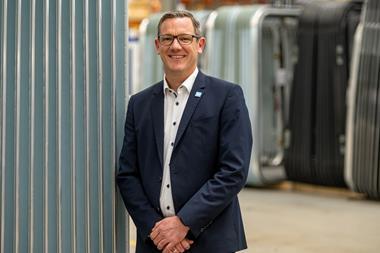
 Dr. Charles Calvert is a co-founder and principle systems architect at Vanguard Sustainable Transport Solutions. He is a specialist in low-carbon rail traction and alternative energy systems. A former Royal Navy submarine service engineer, he holds a PhD in engineering from the Birmingham Centre for Railway Research and Education and has worked extensively across hydrogen and hybrid rail technologies, including leading roles in the HydroFLEX and HydroShunter projects.
His work focuses on the practical deployment of decarbonisation solutions within operational railway environments, bridging engineering innovation with real-world operational and commercial constraints. He currently works at Vanguard Sustainable Transport Solutions on strategic traction and fleet energy initiatives, with a particular interest in scalable pathways to railway decarbonisation and energy transition using batteries and hydrogen fuel cells.